
IP20 Explained: Indoor LED Strip Compliance for Commercial, Hospitality & Retail
IP20 Explained: Indoor LED Strip Compliance for Commercial, Hospitality & Retail
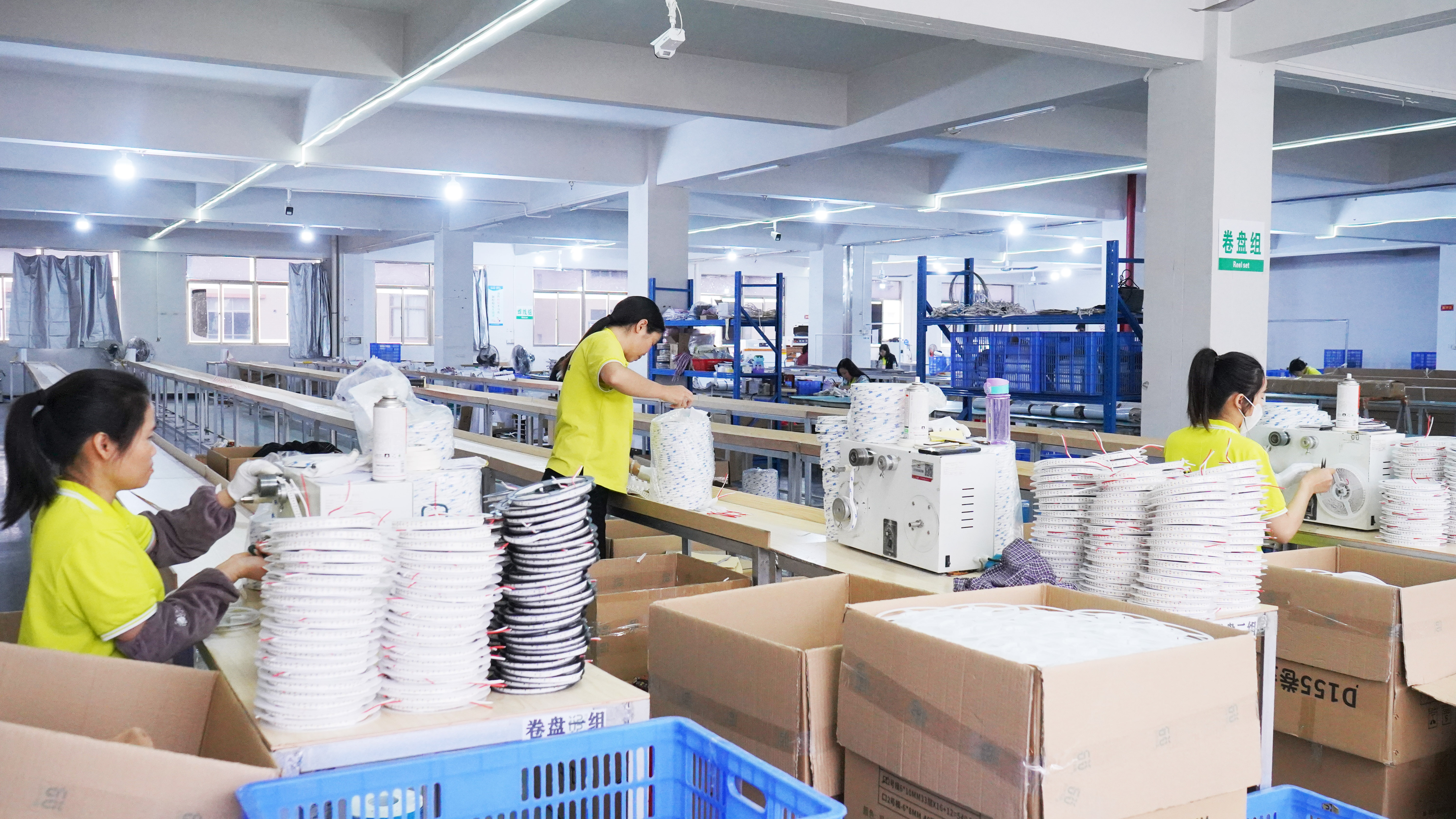
IP20 is a dry-location rating: it protects against solid objects of 12.5 mm and larger, and offers no protection against water at all. That makes IP20 LED Strip Light models the correct specification for commercial interiors, hotel guestrooms, corridors and retail displays — and the wrong specification for bathrooms, kitchens, unheated canopies, façades, or any zone where condensation, spray or standing water can reach the strip.
This guide explains what IP20 does and does not cover, which XPUP LED Strip Light models carry a verified IP20 rating across both 2835 and 3535 LED formats, how IP20 sits inside the CE compliance file for EU buyers, and the exact checks to run before a purchase order is confirmed.
Problem Definition: Why IP20 Is Mis-Specified So Often
The IP code contains two digits, and only one of them concerns solids or dust. In an IP20 rating, the first digit (2) means the enclosure protects against solid foreign objects of 12.5 mm diameter and larger. The second digit (0) means there is no protection against water ingress whatsoever.
Two procurement errors follow from that:
- Treating “IP” as a quality grade. A higher IP number does not mean better light quality, longer life or better colour consistency. It only describes ingress conditions.
- Assuming certification equals moisture protection. CE marking covers safety, electromagnetic compatibility and hazardous substances. It does not certify an IP rating, and a fully CE-compliant LED Strip Light can still be the wrong product for a wet zone.
In practice, IP20 problems in commercial and hospitality interiors are rarely caused by dust. They are caused by moisture reaching the strip from an unconsidered direction: condensation above a shower ceiling void, splash from a kitchen pass, cleaning water on a retail counter, humidity in a spa corridor, or an unheated entrance detail that collects condensation overnight. Once water reaches the FPC, the typical consequences are connector oxidation, adhesive lift and progressive colour shift — conditions that are installation-related, not manufacturing defects.
Industry Background: Why Ingress Ratings Now Sit in the Procurement File
LED strip continues to take share from conventional linear lighting, and that shift has pushed ingress ratings into mainstream specification documents rather than specialist detailing.
- The global LED strip market was valued at approximately USD 5.8 billion in 2025 and is projected to reach USD 13.2 billion by 2034, a CAGR of 9.6% (Dataintelo).
- Flexible LED strips represent the largest product type, holding a 67.4% share as of 2025 (Dataintelo).
- Commercial applications contribute approximately 33.8% of global LED strip revenue (Dataintelo, 2024) — the same segment where IP ratings are specified most often.
- More than 65% of new architectural lighting installations in 2025 are reported to use LED strip technology (Business Research Insights).
- The 24V segment accounted for 52.0% of linear LED strip fixture market revenue in 2022 (Grand View Research), which matches the 24V DC architecture used across most XPUP indoor models.
Standards activity runs in parallel. IEC 60598-2-20:2022 specifies safety requirements for lighting chains including LED strips. In the United States, low-voltage 12V/24V LED strips are classified under UL 2108, while UL 1598 covers luminaires installed in storage areas such as clothes closets — relevant for Household LED Strip Light applications. In the EU, Ecodesign and Energy-related Products requirements under the Green Deal continue to raise the documentation bar for imported linear lighting.
Quality LED strips are generally rated for 30,000 to 50,000 hours of operation, and LED strips consume roughly 70% less power than traditional incandescent systems (Business Research Insights). Those figures describe the product category, not the installation. The installation is where the IP rating decides whether the promised life is actually delivered.
Detailed Solution: Verified IP20 Models in the XPUP LED Strip Range
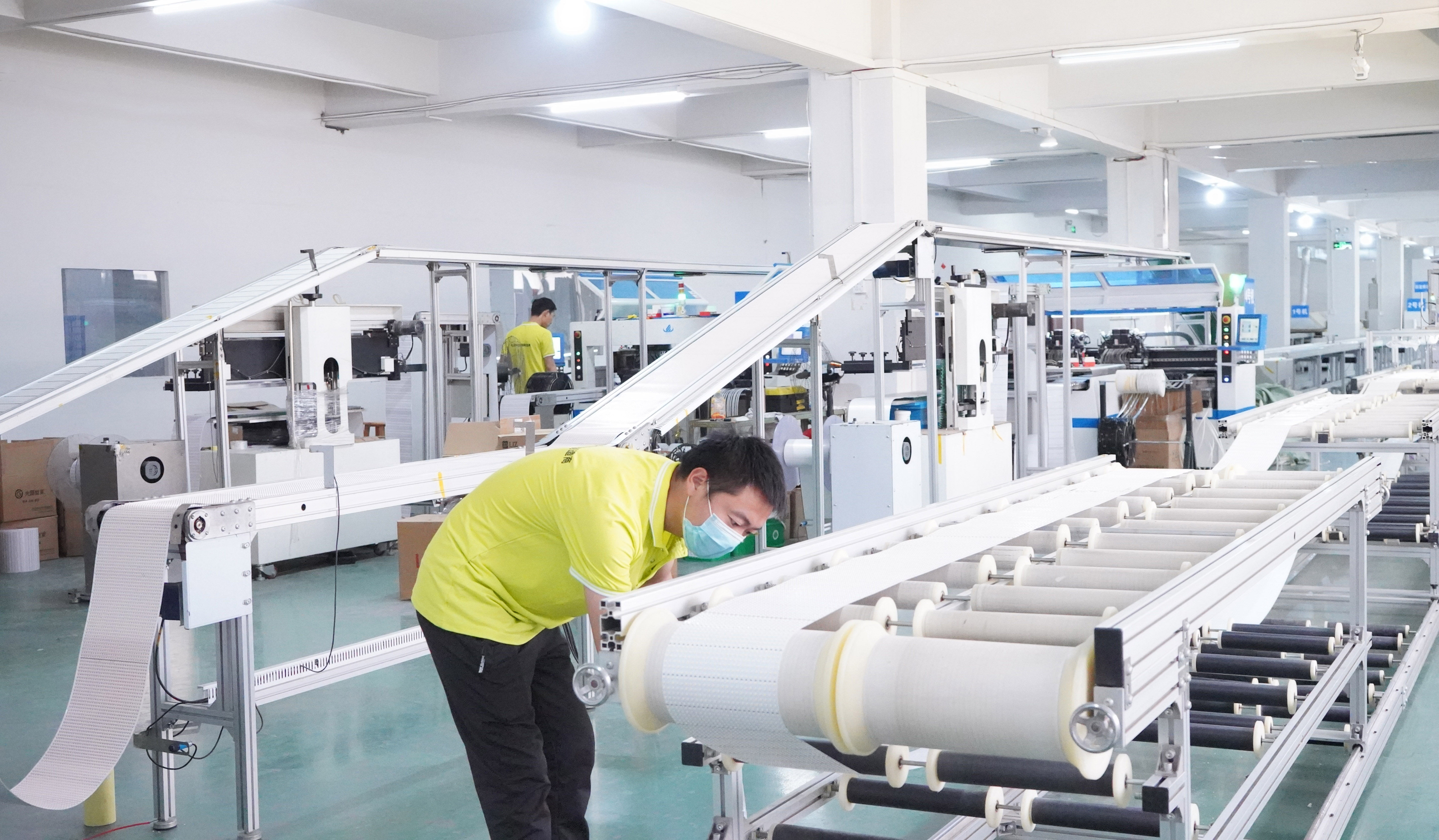
XPUP — Zhongshan Xiangpai (XPUP) Lighting Technology Co., Ltd. — is a LED strip manufacturer established in 2012 in Zhongshan, Guangdong, China, operating a 10,000 m² factory with 80 employees, six R&D engineers and an annual output of 35,000,000 meters. Around 50% of production is exported, with the EU and USA as the main markets, and products are CE and RoHS certified. The company supplies both OEM and ODM programmes with an MOQ of 2,000 meters, a typical lead time of 18–22 days, and a monthly capacity of 3,000,000 meters.
IP20 in 2835 SMD constructions
The 2835 SMD platform carries the widest IP20 selection in the XPUP portfolio. The table below lists verified IP20 models with their datasheet specifications.
| Model | Product type | Voltage | Power | CRI | LEDs/m | Output / CCT |
|---|---|---|---|---|---|---|
| XP-A10DC24V-2835-120D-8mm | Low Voltage LED Strip Light | 24V / 220V | 8W | Ra≥80 | 120 | 21–23 lm/LED |
| XP-B10DC24V-2835-120D-8MM | Household LED Strip Light | 24V | 10W | Ra≥90 | 120 | 40–45 lm/LED |
| XP-D11DC24V-2835-120D-8MM | Tunable LED Strip Light | 24V | 11W | Ra≥95 | 120 | 24–26 lm/LED, 2700K–6000K |
| XP-D4DC24V-2835-192D-8MM | Dimmable LED Strip Light | 24V | 15W | Ra≥95 | 192 | 24–26 lm/LED, 2700K–6500K |
| XP-BD18DC24V-2835-140D-8MM | DC LED Strip Light | 24V | 12W | Ra≥97 | 140 | 55–65 lm/LED, 2700–6000K |
| G7-DC24V-2835-126D-8mm | Energy Saving LED Strip Light | 24V | 5W | Ra≥80 | 126 | 34–36 lm/LED |
| G10-DC24V-2835-238D-10mm | High Luminous Efficiency LED Strip Light | 24V | 25W | Ra≥80 | 238 | 34–36 lm/LED |
| B7-DC24V-2835-180D-10MM | Flexible LED Strip Light | 24V | 15W | Ra≥90 | 180 | 24–26 lm/LED |
| CA-DC24V-2835-180D-8mm-3000K | Acoustic Wall LED Strip Light | 24V | 11W | Ra≥80 | 180 | 3000K, 2.4 m / 3 m per strip |
| XP--BD14-DC24V-2835-144D-8MM | Hospitality Lighting | 24V | 12W | Ra≥95 | 144 | 2700–6000K |
| XP-A9DC24V-2835-120D-8MM | Indoor Lighting | 24V | 10W | Ra≥80 | 120 | 3000 / 4000 / 6000K |
| DK3-DC24V-2835-240D-9.3mm | Linear Lighting | 24V | 15W | Ra≥80 | 240 | 3000 / 4000 / 6500K |
| XP-ZS-DC24V-2835-8MM | Decorative Lighting | 24V | 10W | Ra≥80 | 60 / 140 | 30–35 lm/LED |
Higher-output indoor options sit on the same IP20 basis: the Ultra Bright LED Strip Lights format G10-DC24V-2835-182D-8mm runs at 24V, 25W with 160 lm/LED, and the AI LED Strip Light XP-B7DC24V-2835-240D-10MM runs at 24V, 15W, Ra≥90 with 130 lm/W.
IP20 in 3535 constructions
The 3535 platform is represented by the multi-colour model, which is rated IP20 and listed for commercial, hospitality and retail lighting:
- XP-D5DC24V-3535-120D-8MM — Multi-Color LED Strip Light: 24V, 8W, 8 mm PCB, RGB, 120 LEDs/m, IP20. Datasheet application scope: Commercial Lighting, Hospitality Lighting, Retail Lighting.
That pairing matters during evaluation. Buyers sometimes assume a colour-changing strip is automatically moisture-tolerant. The verified rating says otherwise: a 3535 multi-colour strip can be IP20, so the moisture assessment still governs the decision.
Other IP20 formats for interior work
- XP-D6DC24V-5050-60D-10MM — RGBIC LED Strip Light / Smart LED Strip Light: 24V, 10W, 10 mm PCB, RGBIC, 60 LEDs/m, 5050, IP20.
- XP-SM-DC24V-5050-10MM — Smart Lighting: 24V, 12W, Ra≥90, RGB or 3000K / 4000K / 6000K, 60D / 120D, 5050 / 2835, IP20.
- XP-D8DC24V-5050-60D-12MM — Ambient LED Strip Light: 24V, 15W, 12 mm PCB, RGBCW, 60 LEDs/m, IP20.
- XP-D14DC24V-5050-60D-10MM — Ambient Lighting: 24V, 12W, 10 mm PCB, RGB, 60D, 5050, IP20.
- XP-C10DC24V-2835-120D-8MM — Neon LED Strip Light: 24V, 8W, Ra≥90, 8 mm PCB, 120 LEDs/m, IP20.
The Neon LED Strip Light example is the clearest illustration of why datasheets beat assumptions. A neon-style diffused appearance suggests an outdoor product to many specifiers, yet the verified rating for this model is IP20. Appearance is not a compliance document.
How IP20 interacts with the CE compliance file
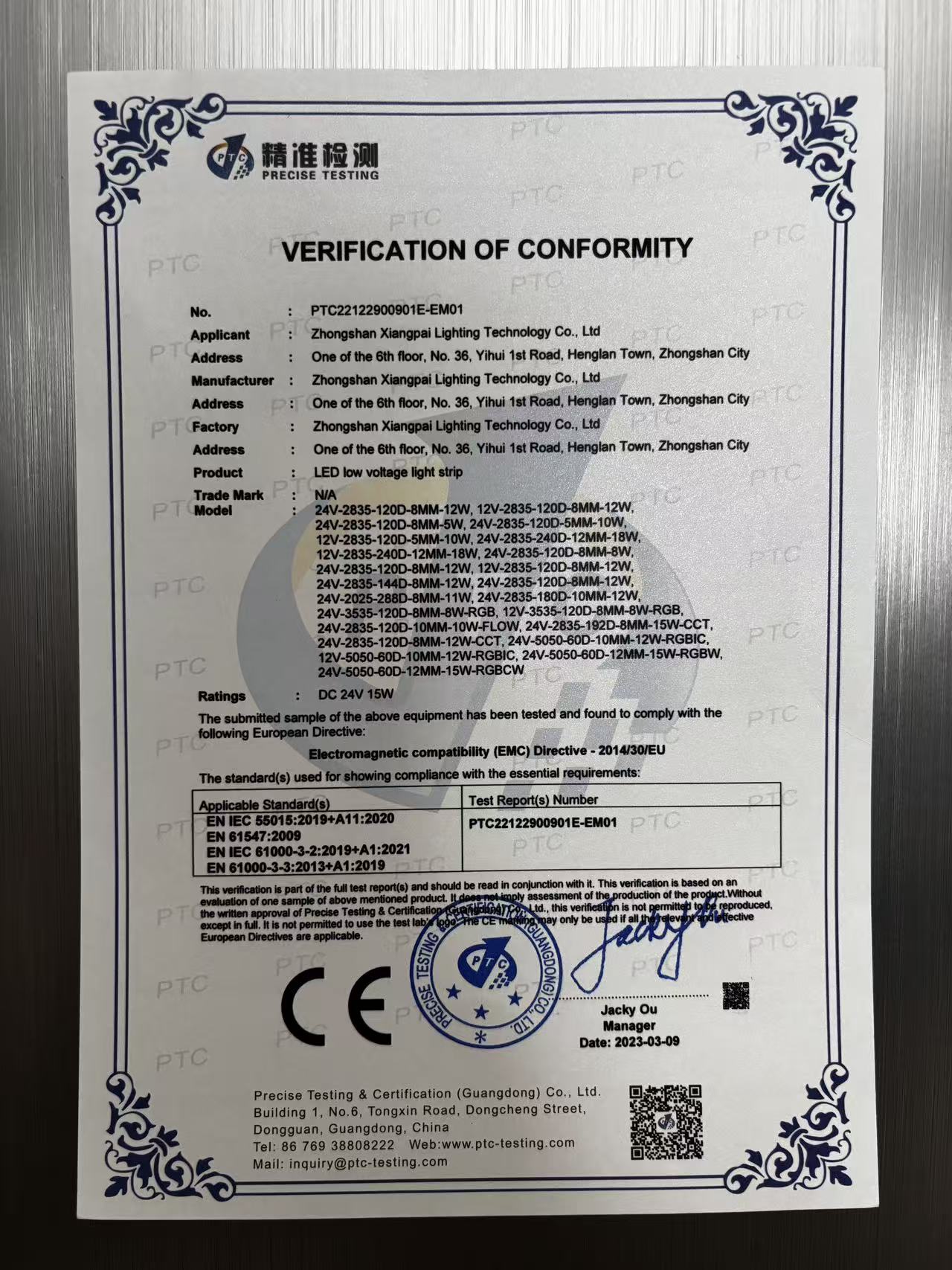
EU buyers evaluating an indoor LED Strip Light should be able to trace three certificate families, all issued by PTC TESTING for the EU market and covering the LED low-voltage and high-voltage light strip series:
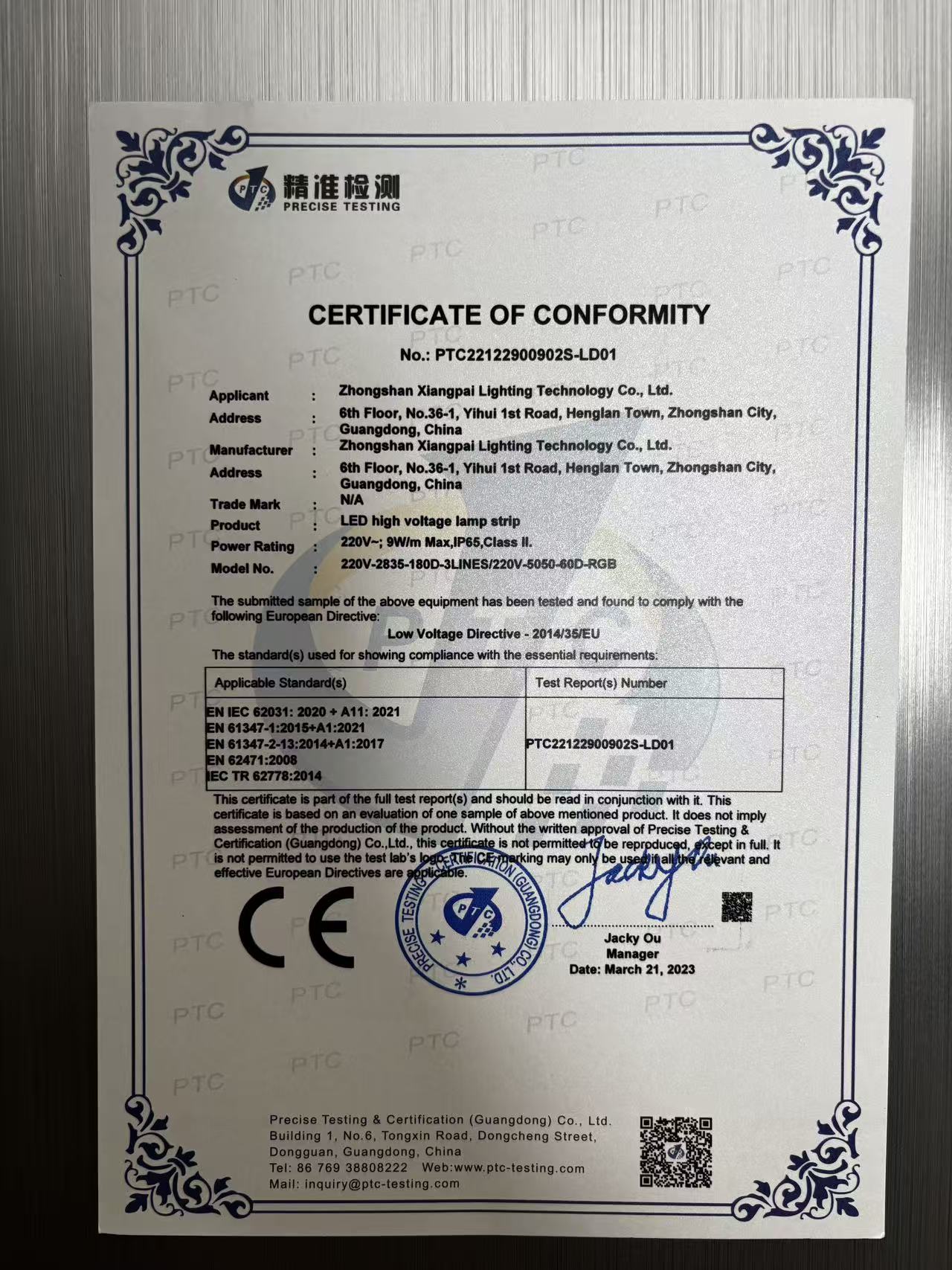
- LVD (CE) — certificates PTC22122900901S-LD01 and PTC22122900902S-LD01, issued 2023-04-04, against EN IEC 62031:2020+A11:2021, IEC TR 62778:2014 and EN 62471:2008.
- EMC (CE) — certificates PTC22122900901E-EMB01 and PTC22122900902E-EMB01, issued 2023-03-09, against EN IEC 55015:2019+A11:2020, EN 61547:2009, EN IEC 61000-3-2:2019+A1:2021 and EN 61000-3-3:2013+A1:2019.
- RoHS — certificates PTC22122900903C-EN01 and PTC22122900905C-EN01, issued 2023-04-23, against the IEC 62321 series.
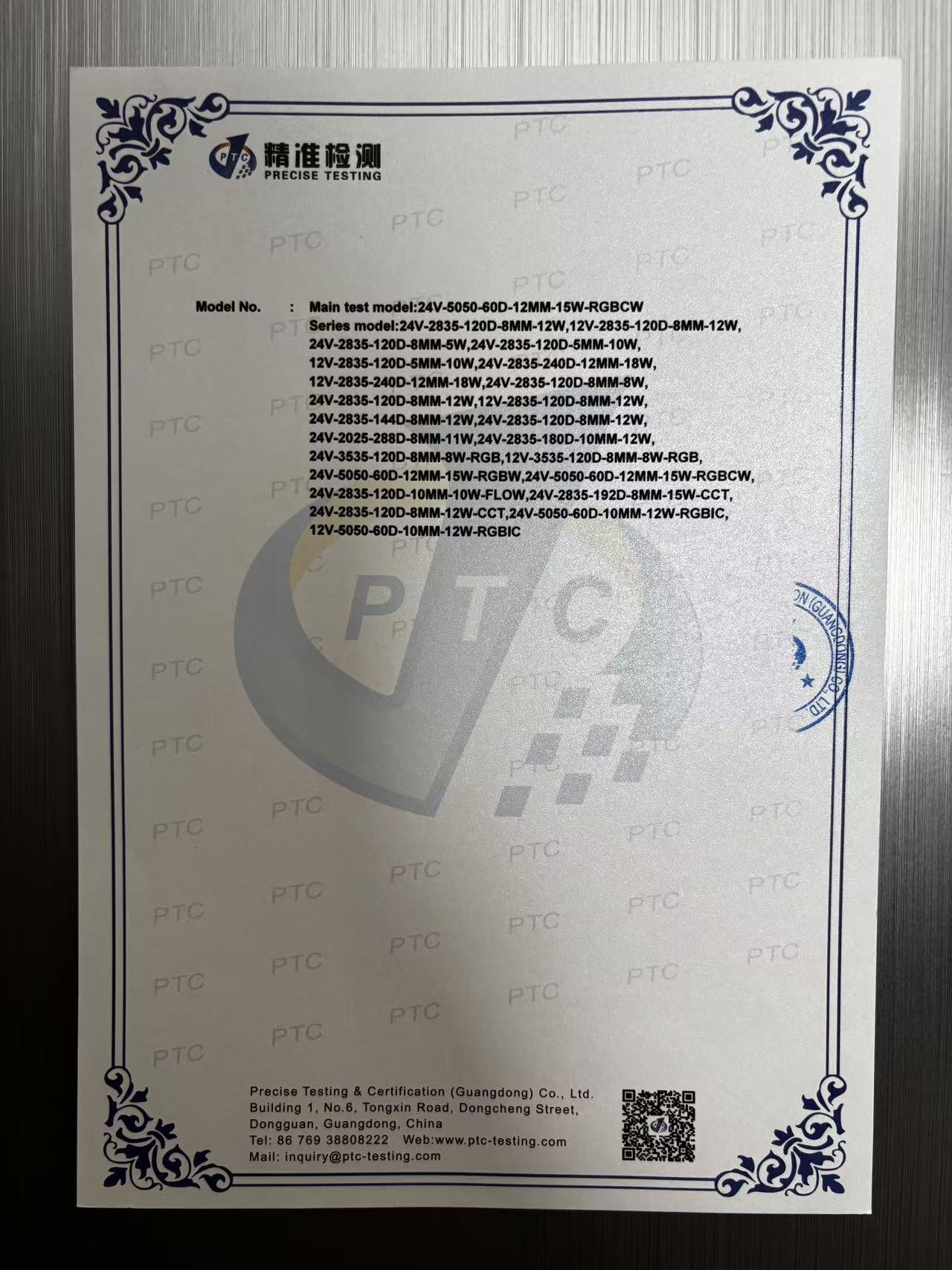
These documents answer the safety, EMC and hazardous-substance questions. They do not answer the moisture question. Keep the IP rating and the certification file as two separate checks in the evaluation record.
Step-by-Step Breakdown: Evaluating IP20 Before You Order
- Classify every lighting zone by moisture exposure. Dry (offices, guestrooms, corridors, retail displays), transitional (splash-adjacent counters, kitchen pass-throughs) and wet (bathrooms, spa areas, exteriors, landscape). Only the dry zone should proceed to IP20.
- Pull the rating from the exact model datasheet. Confirm the IP rating on the part number you intend to buy, not on a family page or an illustrated catalogue spread.
- Read the second digit. If it is 0, there is no water protection. Plan a different zone, a different enclosure, or a different model.
- Rate the driver, connectors and end-caps separately. Ingress protection is a system property; a single exposed connector negates an IP20 plan in a damp void.
- Verify the compliance file. Request the LVD, EMC and RoHS certificates with certificate numbers, issuing authority, scope and the standards cited — not just the CE logo.
- Confirm the mounting condition. Aluminium channels with diffusers, cove details and profile extrusions create a micro-environment. A closed channel in a cool interior behaves differently from an open adhesive run across a concrete soffit.
- Validate with a sample. XPUP applies 100% product testing as standard quality control, and sample confirmation is part of the standard order flow for customised programmes. Test the sample in the actual mounting condition before mass production.
- Lock the commercial terms. For XPUP indoor programmes the MOQ is 2,000 meters, typical lead time is 18–22 days, and after-sales support includes online remote support, general technical guidance and a 2-year standard warranty.
Use Cases: Where IP20 Is the Right Answer
Commercial interiors
Office cove lighting, meeting-room detail, reception features and linear wayfinding are all dry-location applications. Commercial LED Strip Lights in the high-output formats — such as G10-DC24V-2835-238D-10mm at 25W with 238 LEDs/m — are typically specified where brightness per metre matters more than moisture resistance.
Hospitality
Guestrooms, corridors, lobbies and back-of-house circulation are dry zones suited to IP20. The Hospitality Lighting model XP--BD14-DC24V-2835-144D-8MM is rated IP20 at 24V, 12W, Ra≥95 with a 2700–6000K range, supporting the warm, high-CRI light quality hotel interiors usually require. The Tunable LED Strip Light XP-D11DC24V-2835-120D-8MM covers the same ground with a continuous 2700K–6000K tuning range at Ra≥95.
Where hospitality projects mix dry and wet zones, the specification should split early. A German hospitality project of 20,000 meters combined indoor and outdoor hotel lighting and relied on IP68 protection for the wet elements, with consistent brightness and colour quality maintained over four years of operation. The lesson is not that IP68 is preferable — it is that one rating cannot serve a mixed-zone brief.
Retail
Display cases, shelf lighting and signage are dry, dust-managed environments where IP20 multi-colour options deliver the flexibility retail designers want. The 3535 Multi-Color LED Strip Light, the RGBIC and Smart LED Strip Light models, and the Ambient RGBCW strip all sit in the IP20 range and are listed for commercial, hospitality and retail use.
Acoustic wall and design details
Acoustic panel lighting is an interior detail where strip flexibility and colour consistency matter more than ingress protection. The Acoustic Wall LED Strip Light CA-DC24V-2835-180D-8mm-3000K is rated IP20 at 24V, 11W, Ra≥80, 180 LEDs/m, supplied in 2.4 m and 3 m strip lengths, and supports OEM and ODM programmes.
Case evidence from delivered projects
- A German café and chain retail programme installed 50,000 meters of LED strip over two years, with flicker-free dimming cited as the commercial-grade requirement.
- A German DIY retail channel received 100,000 meters per year for six years, including retail packaging customisation and a complete product portfolio.
- A U.S. lighting brand programme delivered 300,000 meters per year over three years, covering product specifications, colour parameters, certification requirements and packaging customisation under an ODM model.
- A Germany and Italy residential ambient programme of 20,000 meters per year over three years used precision customisation and acoustic panel lighting solutions.
In each case the indoor, dry nature of the installation was established first; the IP rating followed from it.
Comparison Table: IP20 vs IP65 vs IP68 for Indoor and Mixed Projects
| Rating | Solid / dust protection | Water protection | Verified XPUP example model | Typical deployment |
|---|---|---|---|---|
| IP20 | Objects ≥ 12.5 mm (first digit 2) | None (second digit 0) | XP-D5DC24V-3535-120D-8MM (Multi-Color); B7-DC24V-2835-180D-10MM (Flexible) | Dry interiors: offices, hotel guestrooms and corridors, retail displays, acoustic wall details |
| IP65 | Dust-tight (first digit 6) | Water jets (second digit 5) | XP-C13DC24V-6060-48D-10MM (Commercial LED Strip Lights, 24V, 18W, Ra≥90, 6060, 48 LEDs/m, 110–120 lm/LED) | Transitional interiors where splash or cleaning water may reach the strip |
| IP68 | Dust-tight (first digit 6) | Continuous immersion (second digit 8) | XP-C5DC24V-2835-120D-8MM (Waterproof LED Strip Light, Ra≥90); XP-C818DC24V-2835-120D-8MM (Silicone LED Strip Light); XP-CH1DC24V-2025-280D-8MM (COB LED Strip Light, 280 LEDs/m) | Wet interiors, courtyards, façades, landscape and outdoor applications |
The same logic applies to systems. The 220V Outdoor LED Strip Light XP-CH2AC220V-2025-240D-8MM is a silicone-tube construction rated IP68 for landscape, garden and bridge lighting — a different product, a different specification and a different procurement conversation from any IP20 indoor model.
Two market observations support a two-tier specification strategy. High-density LED strip variants above 120 LEDs/m are estimated to account for nearly 19% of premium installations, and the 3000K–4000K colour temperature band held a 33.2% revenue share in the linear LED strip fixture market (Grand View Research, 2022). In other words, volume sits in warm-white, high-density indoor work — precisely the zone where IP20 is correct, provided the moisture check is done properly.
FAQ: IP20 LED Strip Questions Buyers Ask Before Ordering
1. Does an IP20 LED strip still need CE certification to enter the EU?
Yes. IP rating and CE marking answer different questions, and both are required. IP20 describes ingress protection only. CE covers safety, electromagnetic compatibility and hazardous substances. The XPUP LED strip range holds CE documentation issued by PTC TESTING for the EU market, comprising LVD certificates PTC22122900901S-LD01 and PTC22122900902S-LD01 (issued 2023-04-04), EMC certificates PTC22122900901E-EMB01 and PTC22122900902E-EMB01 (issued 2023-03-09), and RoHS certificates PTC22122900903C-EN01 and PTC22122900905C-EN01 (issued 2023-04-23), all within the scope of the LED low-voltage and high-voltage light strip series.
2. Can IP20 LED strip be used in a hotel bathroom or a commercial kitchen?
Not directly. IP20 provides no water protection, so bathrooms, spa areas, kitchen splash zones and any surface subject to condensation or cleaning water fall outside its scope. Those zones should move to IP65 or IP68 models such as XP-C5DC24V-2835-120D-8MM, XP-C818DC24V-2835-120D-8MM, or the COB model XP-CH1DC24V-2025-280D-8MM. For dry hotel and retail zones the IP20 range remains appropriate and includes customisable options: XPUP supports OEM customisation of voltage, logo, power, dimensions, materials, hardware configuration, internal circuit, colour, factory specifications, nameplate and label, and ODM customisation of exterior colour scheme, outer packaging box, label, brand information, model name and material details.
3. What drives the price difference between IP20 and higher-IP LED strips?
The difference sits in materials and process steps rather than light output. Higher-IP constructions add silicone coating, silicone tube extrusion or lens structures plus the additional sealing, curing and testing operations that follow. IP20 models such as XP-A10DC24V-2835-120D-8mm and B7-DC24V-2835-180D-10MM avoid those steps, so they are the more economical choice for dry interiors — provided the moisture assessment genuinely supports IP20. Specifying IP68 “for safety” in a dry corridor adds cost without adding protection value.
4. How should we validate an IP20 strip before committing to mass production?
Run a sample in the real mounting condition. XPUP applies 100% product testing as standard quality control, and after-sales support covers online remote support, general technical guidance and a 2-year standard warranty. A sample placed in the actual channel, at the actual ambient temperature, with the actual dimming protocol, reveals more than a catalogue comparison. To request samples or a project-specific quotation, contact sales001@xpupled.com or message +86 189 8858 4085 on WhatsApp/WeChat.
5. What are the typical MOQ and lead time for an IP20 indoor programme?
For XPUP indoor LED strip programmes, the minimum order quantity is 2,000 meters and the typical production lead time is 18–22 days, supported by a monthly capacity of 3,000,000 meters. Export experience covers the EU, Asia and the US. Buyers preparing a full specification pack can download the 2026 XPUP LED Strip Catalog and match IP-rated models to each project zone before ordering.
Conclusion: Decide the Zone First, the Rating Second
IP20 is not a compromise. It is the correct rating for dry indoor LED Strip Light installations across commercial, hospitality and retail interiors — and it is the wrong rating the moment moisture can reach the strip. The evaluation sequence is straightforward: classify the zone, read the second digit of the IP code, verify the model datasheet, verify the CE compliance file separately, validate a sample in situ, and confirm MOQ and lead time before the order is released.
For projects where dry and wet zones sit in the same building, split the bill of materials early. XPUP supplies IP20 indoor models across 2835, 3535 and 5050 platforms, IP65 models for transitional areas, and IP68 silicone and COB constructions for wet and outdoor work — from one source, under one compliance file, with OEM and ODM customisation available.
Planning an indoor LED strip programme?
Download the 2026 XPUP LED Strip Catalog for full model specifications, or send your zone-by-zone lighting schedule to sales001@xpupled.com for a tailored recommendation and sample arrangement.
Website: www.xpupled.com · WhatsApp/WeChat: +86 189 8858 4085 · Catalog: 2026 XPUP LED Strip Catalog (PDF)
Structured Data
Have Questions or Need More Details?
Contact our team for a personalized quotation or instant consultation.
Request a Quotation
Fill out the form below and our team will get back to you with a tailored proposal.
WhatsApp Direct Chat
Prefer to chat in real-time? Message us on WhatsApp for instant assistance & quick answers.
- Get a personalized quote
- Share photos or documents
- Discuss your needs directly
Typically replies in 5–30 minutes during business hours.