
LED Lighting Technical Guide: Museum and Gallery Selection by CRI, CCT, Voltage, and Density
Museum and gallery lighting is decided by four published parameters before price is ever discussed: colour rendering index (CRI), correlated colour temperature (CCT), operating voltage, and LED density. A strip that passes a general commercial specification can still be rejected by a curator or lighting designer if any one of those four numbers is wrong.
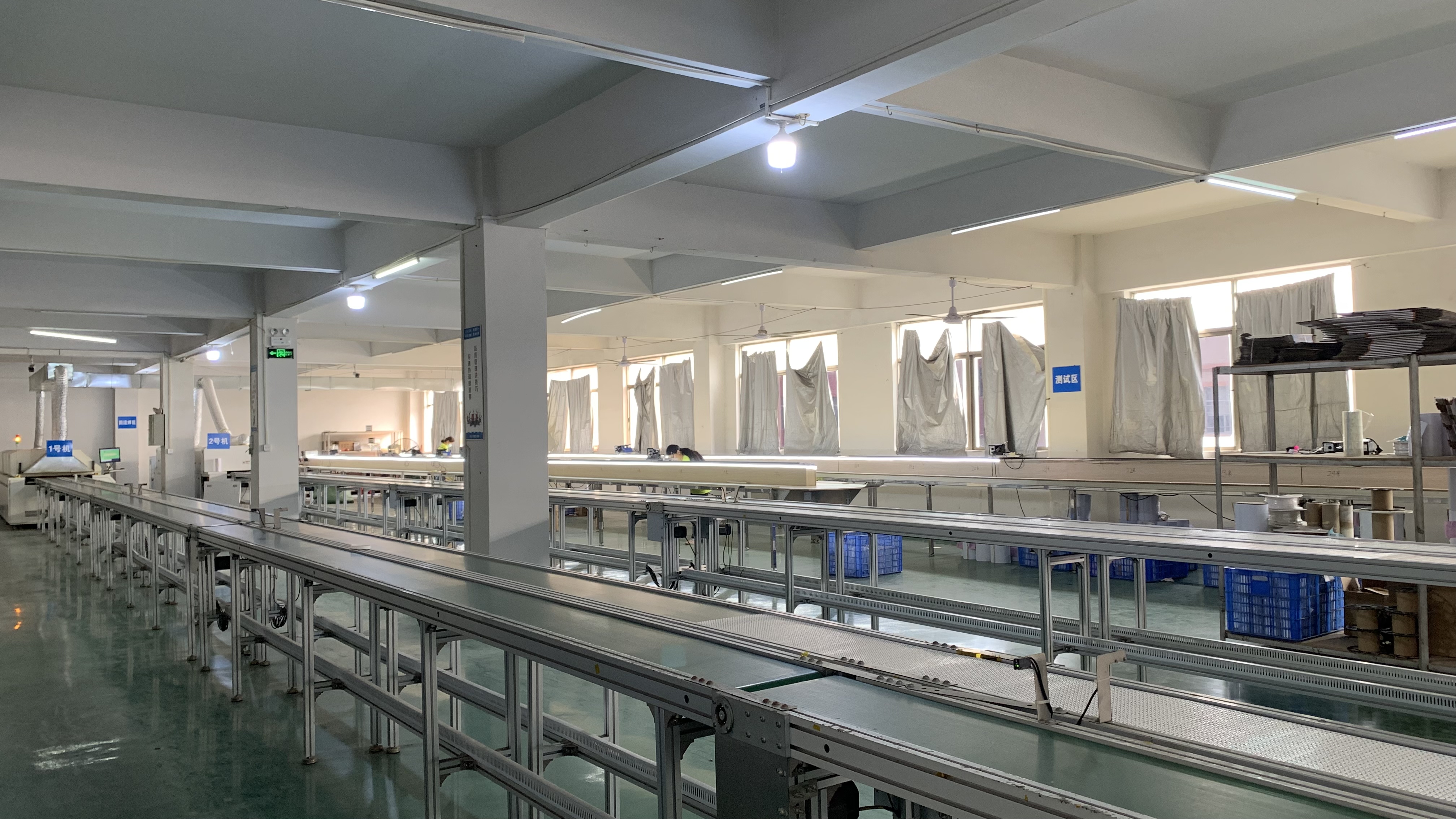
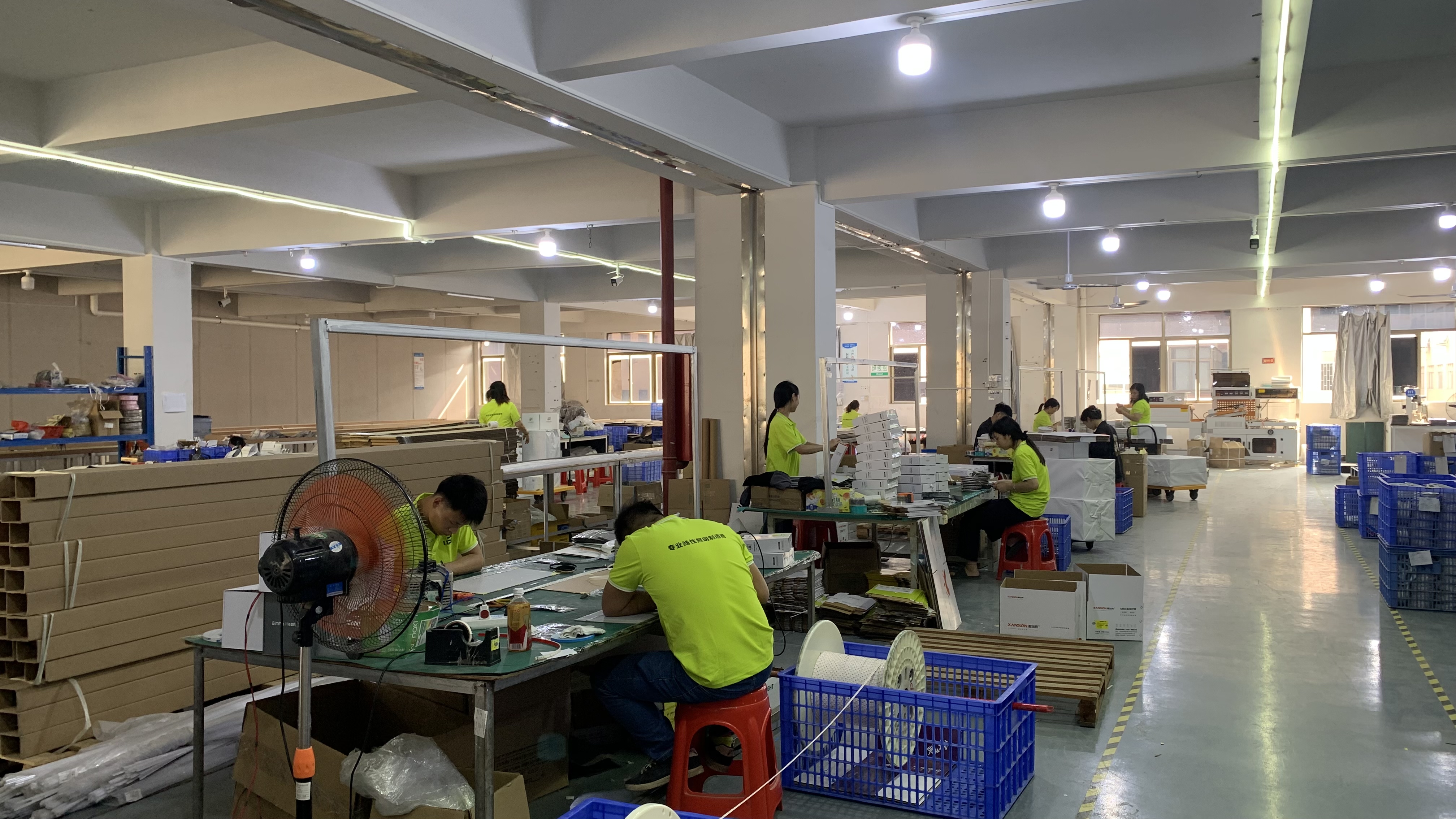
This technical guide explains how each parameter is evaluated for exhibition spaces and uses two XPUP LED models as working reference points: DK3-DC24V-2835-240D-9.3mm and XP-BD18DC24V-2835-140D-8MM. XPUP LED is the export brand of Zhongshan Xiangpai (XPUP) Lighting Technology Co., Ltd., an LED strip and linear lighting manufacturer established in 2012 in Zhongshan, China, with a 10,000 m² factory, a 6-engineer R&D team, an annual output of 35,000,000 meters of LED strip, and exports to EU and USA markets.
Direct answer. For colour-critical exhibit positions, specify XP-BD18DC24V-2835-140D-8MM — full spectrum lighting rated CRI Ra≥97, 24V, 12W, 140 LEDs per meter, 8mm double-layer copper PCB, IP20, CCT options 2700/3000/3500/4000/5000/6000K. For architectural, circulation and general gallery lighting where Ra≥80 is acceptable, specify DK3-DC24V-2835-240D-9.3mm — linear lighting rated Ra≥80, 24V, 15W, 240 LEDs per meter, 9.3mm double-layer copper PCB, IP20, CCT options 3000/4000/6500K. Both models are IP20 and both are available with OEM and ODM customization.
Problem Definition: Why General-Purpose LED Strip Specifications Fail in Exhibitions
Most LED strip catalogues are organised around wattage, lumen output and price per meter. In an exhibition environment those three numbers determine very little. Gallery specifications typically fail for one of five recurring reasons:
- Rendering is invisible on a datasheet. Two strips with identical power ratings can render the same textile, pigment or stone very differently. CRI is the parameter that separates them, and it is the first number omitted from a low-cost quotation.
- Density is under-specified. Low-density strips produce visible bright points on polished floors, glass display cases and reflective wall finishes, so the LED pattern becomes part of the exhibit instead of the lighting.
- The white point drifts along a run. Without a defined CCT set and batch-to-batch colour control, adjacent wall sections can read as two different whites under the same specification heading.
- Voltage and driver assumptions are left to installation. A 24V DC strip requires the driver count, driver location and voltage-drop plan to be settled at design stage, not discovered on site.
- Documentation gaps break tenders. Institutional and public projects require certification evidence and a pre-shipment acceptance test, not a product photograph.
Industry Background: Where Museum and Gallery Lighting Sits
Exhibition lighting is a small, high-specification slice of the wider commercial lighting market. Grand View Research valued the global LED lighting market at USD 106.9 billion in 2025 and projects USD 197 billion by 2033, while the commercial lighting segment was estimated at USD 47.54 billion in 2024. The IEA reported that the lighting sector accounted for approximately 8% of global electricity demand in 2024, roughly 2,200 TWh — which is why efficiency remains part of every specification conversation even in low-volume cultural projects.
Two structural shifts are visible on the specification side. Human centric lighting, the segment concerned with tunable and biologically appropriate white light, was valued at USD 3.66 billion in 2024 with a projected CAGR of 17.1% through 2036 (Research Nester). At the same time, control requirements are tightening: the 2024 International Energy Conservation Code requires commercial interior lighting to dim to 10% or lower (International Code Council), which moves dimming behaviour into the acceptance criteria of gallery and museum projects.
For museums and galleries, that combination points to one technical core: accurate rendering, a stable white point, and predictable behaviour at low dimming levels. The four parameters below are how those requirements are actually written into a specification.
The Four Decision Parameters for Museum and Gallery LED Lighting
1. CRI: The First Filter
CRI (Ra) describes how faithfully a light source renders colour against a reference source. In practice, specifiers use it as a threshold rather than a gradient: colour-critical positions are placed in the highest available band, while circulation and architectural zones can accept a lower band.
XPUP's published data shows both bands clearly. The full spectrum model XP-BD18DC24V-2835-140D-8MM is rated Ra≥97. The linear lighting model DK3-DC24V-2835-240D-9.3mm is rated Ra≥80. That gap is the single most consequential decision in a gallery project, because it determines whether a strip can sit directly above a display case or is better deployed on ceilings, coves, corridors and architectural detail.
Decision rule: if the strip falls inside the visitor's colour-critical view — display cases, painting walls, textiles, jewellery counters, education displays — specify Ra≥97. If it only defines architecture, use the higher-density Ra≥80 option and spend the upgrade budget where rendering actually matters.
2. CCT: White Point and Consistency
Correlated colour temperature sets the white point of the installation. Museum and gallery schemes commonly standardise on warm white for sensitive displays, and use neutral or cooler whites where the architecture calls for it or where the project has to reconcile artificial light with daylight ingress.
Both reference models publish a defined CCT set rather than a single fixed white. DK3-DC24V-2835-240D-9.3mm offers 3000K, 4000K and 6500K. XP-BD18DC24V-2835-140D-8MM offers a wider range: 2700K, 3000K, 3500K, 4000K, 5000K and 6000K. The six-value range on the full spectrum model is the practical reason it suits mixed exhibition programmes, where one room is calibrated warm and an adjacent retail or education area is calibrated neutral.
Where a scheme needs the white point to change over the day — the direction pursued by circadian lighting and human centric lighting specifications — a tunable model such as XP-D11DC24V-2835-120D-8MM (24V, 11W, Ra≥95, 120 LEDs per meter, 8mm PCB, CCT range 2700K–6000K, IP20) delivers CCT change instead of a fixed white point.
3. Voltage: 24V DC and Driver Architecture
DK3, XP-BD18 and XP-D11 all operate at 24V DC. In museum and gallery installations, 24V DC has three practical consequences: strips can be cut and re-fed at shorter intervals than high-voltage alternatives, the driver can be located in a service void away from the exhibit, and low-voltage wiring is easier to route behind casework and wall panels.
Voltage selection therefore drives the rest of the electrical design — driver count, driver placement, voltage-drop planning across long runs, and dimming protocol compatibility. The two reference models also draw differently in electrical terms: DK3 is rated 15W and XP-BD18 is rated 12W, a difference that has to be modelled against driver capacity and heat load per run at design stage rather than on site.
4. LED Density and PCB Width
Density is expressed as LEDs per meter and controls how the light reads on a surface. DK3-DC24V-2835-240D-9.3mm carries 240 LEDs per meter, the higher density of the two reference models, which supports a continuous line of light across architectural runs. XP-BD18DC24V-2835-140D-8MM carries 140 LEDs per meter with a published luminous flux of 55–65 lm per LED.
Density and PCB width travel together. DK3 uses a 9.3mm PCB; XP-BD18 uses an 8mm PCB. The narrower 8mm board matters in gallery detailing because it fits the slim aluminium profiles, recessed channels and display-case channels used for wall washing and concealed illumination, where a 9.3mm board would require a wider profile and a larger reveal.
Secondary Parameters: IP Rating, PCB Material, SMD and Beam Angle
Four further values complete the specification and are frequently the ones that cause a late rejection:
- IP rating. Both reference models are rated IP20, which defines them for dry, protected interior installation such as display cases, ceiling coves and interior wall details. Wet or semi-exposed areas require a different construction from the same range, such as the IP68-rated silicone and COB strips.
- PCB construction. Both models use a double-layer copper PCB, the construction XPUP specifies across its low-voltage LED strip series.
- SMD type. Both models use 2835 SMD LEDs, so the density and CRI comparison between them is not affected by a change of LED package.
- Beam angle. Where a manufacturer publishes beam angle data — for example 120° on the XP-CX-18 magnetic track lighting unit — the figure defines the light cone and therefore the spacing needed between runs for even coverage.
Two XPUP Reference Models for Museum and Gallery Projects
DK3-DC24V-2835-240D-9.3mm — High-Density Linear Lighting
DK3-DC24V-2835-240D-9.3mm is classified by XPUP as linear lighting. Its published specification is: 24V, 15W, CRI Ra≥80, 9.3mm PCB, colour temperature 3000/4000/6500K, 240 LEDs per meter, double-layer copper PCB, IP20, SMD 2835, with OEM and ODM available. XPUP lists museums and galleries among its applicable industries, alongside restaurants, interior design, office buildings and apartments.
XP-BD18DC24V-2835-140D-8MM — Full Spectrum Lighting at Ra≥97
XP-BD18DC24V-2835-140D-8MM is classified as full spectrum lighting. Its published specification is: 24V, 12W, CRI Ra≥97, 8mm PCB, colour temperature 2700/3000/3500/4000/5000/6000K, 140 LEDs per meter, 55–65 lm per LED, double-layer copper PCB, IP20, SMD 2835, with OEM and ODM available. XPUP lists museums and galleries, interior design, luxury retail, jewellery stores, education and shopping malls as applicable industries.
Specification Comparison: DK3 vs XP-BD18DC24V-2835-140D-8MM
The table below compares only the values both models publish. Where a value is not published for a model, that is stated rather than estimated.
| Parameter | DK3-DC24V-2835-240D-9.3mm | XP-BD18DC24V-2835-140D-8MM |
|---|---|---|
| Product classification | Linear lighting | Full spectrum lighting |
| CRI | Ra≥80 | Ra≥97 |
| Voltage | 24V | 24V |
| Power | 15W | 12W |
| Colour temperature options | 3000K / 4000K / 6500K | 2700K / 3000K / 3500K / 4000K / 5000K / 6000K |
| LEDs per meter | 240 | 140 |
| PCB width | 9.3mm | 8mm |
| Luminous flux per LED | Not published for this model | 55–65 lm |
| PCB material | Double-layer copper PCB | Double-layer copper PCB |
| SMD | 2835 | 2835 |
| IP rating | IP20 | IP20 |
| OEM / ODM | Available | Available |
| Typical fit in a cultural project | Architectural runs, coves, circulation and general gallery lighting | Colour-critical positions: display cases, painting walls, luxury retail and education displays |
Step-by-Step Breakdown: Specifying a Gallery or Museum LED Run
The eight steps below are the sequence XPUP works through with lighting brands, engineering contractors and interior fit-out teams on museum and gallery orders.
- Classify each lighting zone. Split the project into colour-critical zones (display cases, painting walls, jewellery, textiles) and architectural zones (ceilings, coves, corridors, service areas). This classification alone decides where a Ra≥97 full spectrum strip is required and where a Ra≥80 linear strip is sufficient.
- Write the CRI threshold into the specification. State the Ra value per zone instead of a general note about good colour rendering. Ra≥97 and Ra≥80 are different purchasing decisions and different budget lines.
- Fix the CCT schedule. List the required CCT per zone. DK3 covers 3000/4000/6500K; XP-BD18 covers 2700/3000/3500/4000/5000/6000K. Consistency between adjacent rooms matters more than the individual value chosen.
- Confirm voltage and driver architecture. Both reference models run at 24V DC, so plan driver location, voltage drop across long runs and dimming compatibility before installation drawings are issued. Where the project follows the 2024 IECC dimming threshold for commercial interiors, check behaviour down to the low dimming level, not only at full output.
- Match density and PCB width to the detail. Use 240 LEDs per meter on a 9.3mm PCB where a continuous architectural line is needed, and 140 LEDs per meter on an 8mm PCB where slim profiles, recessed channels or display-case channels are used.
- Confirm IP rating against the environment. DK3 and XP-BD18 are IP20 products for dry, protected interiors. Wet or semi-exposed areas need a different construction, such as the IP68-rated silicone strips in the same manufacturer's portfolio.
- Validate a physical sample. Check the sample against the specified CCT set, PCB width and density on the actual wall finish or case material. XPUP supports rapid sampling and applies 100% product testing.
- Lock documentation, MOQ and lead time before releasing production. MOQ is 2,000 meters, lead time is 18–22 days, delivery terms are FOB or CIF, payment terms are 30% deposit with the balance before shipment, and acceptance is based on pre-shipment testing.
OEM and ODM Customization for Museum and Gallery Orders
Museum and gallery runs are rarely catalogue orders. XPUP operates two customization modes, both stated as available:
- OEM production services: voltage, logo, power, dimensions, materials, hardware configuration, internal circuit, colour, factory specifications, nameplate and label.
- ODM production services: exterior colour scheme, outer packaging box, label, brand information, model name and material details.
Commercial parameters for these orders are published rather than negotiated case by case: monthly capacity 3,000,000 meters, MOQ 2,000 meters, lead time 18–22 days, 100% product testing, and export markets covering the EU, Asia and the US. OEM orders include dedicated technical support, remote debugging, customized parameter guidance and a 2-year warranty; ODM orders include online remote support, general technical guidance and a 2-year standard warranty.
For scale reference, XPUP supplies a US lighting brand with 300,000 meters of ODM LED strip per year for private-label retail and project supply — a three-year relationship covering product specifications, colour parameters, certification requirements and packaging customization.
Use Cases and Related Systems in the Same Project
Museum display cases and painting walls. Where the requirement is faithful rendering of pigment, textile and stone in a fixed warm white, XP-BD18DC24V-2835-140D-8MM at Ra≥97 with 3000K, 3500K or 4000K is the specification to check first, on the strength of its published CRI rating and its role as a full spectrum lighting product.
Gallery coves, wall washing and architectural runs. DK3-DC24V-2835-240D-9.3mm delivers 240 LEDs per meter for continuous lines of light along ceilings, coves and wall reveals, with 3000/4000/6500K options for projects that need to match a daylight-neutral architectural palette.
Retail, jewellery and education spaces inside cultural venues. Museum shops, jewellery counters and education rooms usually share the same lighting standard as the galleries they sit next to. XPUP lists luxury retail, jewellery stores, education and shopping malls among the applicable industries for XP-BD18DC24V-2835-140D-8MM, so the same specification can be carried through from exhibit to retail zone.
Accent and scene control. Where a temporary exhibition needs directional accent light, XPUP publishes XP-CX-18 magnetic track lighting — 48V, 30W, Ra≥90, 8mm PCB, 3000/4000/6000K, 55–65 lm per LED, 120° beam angle, aluminium and PC body — for retail, shopping malls, exhibition and events and jewellery store environments. For scene control, XP-SM-DC24V-5050-10MM smart lighting offers 24V, 12W, Ra≥90, a 10mm PCB, RGB or 3000K/4000K/6000K, 60 or 120 LEDs per meter, 55–65 lm per LED and IP20.
Combined wall treatments and back-of-house areas. Where acoustic panels and lighting are designed as one wall element, XP-CA-DC24V-2835-180D-8mm-3000K acoustic wall lighting publishes 24V, 11W, Ra≥80, 8mm PCB, 3000K, 180 LEDs per meter, 2.4m and 3m strip lengths, IP20, with OEM and ODM. Hospitality and office lighting demands in the same building are served by XP--BD14-DC24V-2835-144D-8MM (24V, 12W, Ra≥95, 144 LEDs per meter, 8mm PCB, CCT 2700/3000/3500/4000/5000/6000K, IP20, OEM and ODM), while energy saving lighting models such as G7-DC24V-2835-126D-8mm (24V, 5W, Ra≥80, 126 LEDs per meter, 34–36 lm per LED, 3000/4000/6500K, IP20) are used for circulation and support areas where rendering is not critical.
Compliance Documentation and Acceptance Criteria
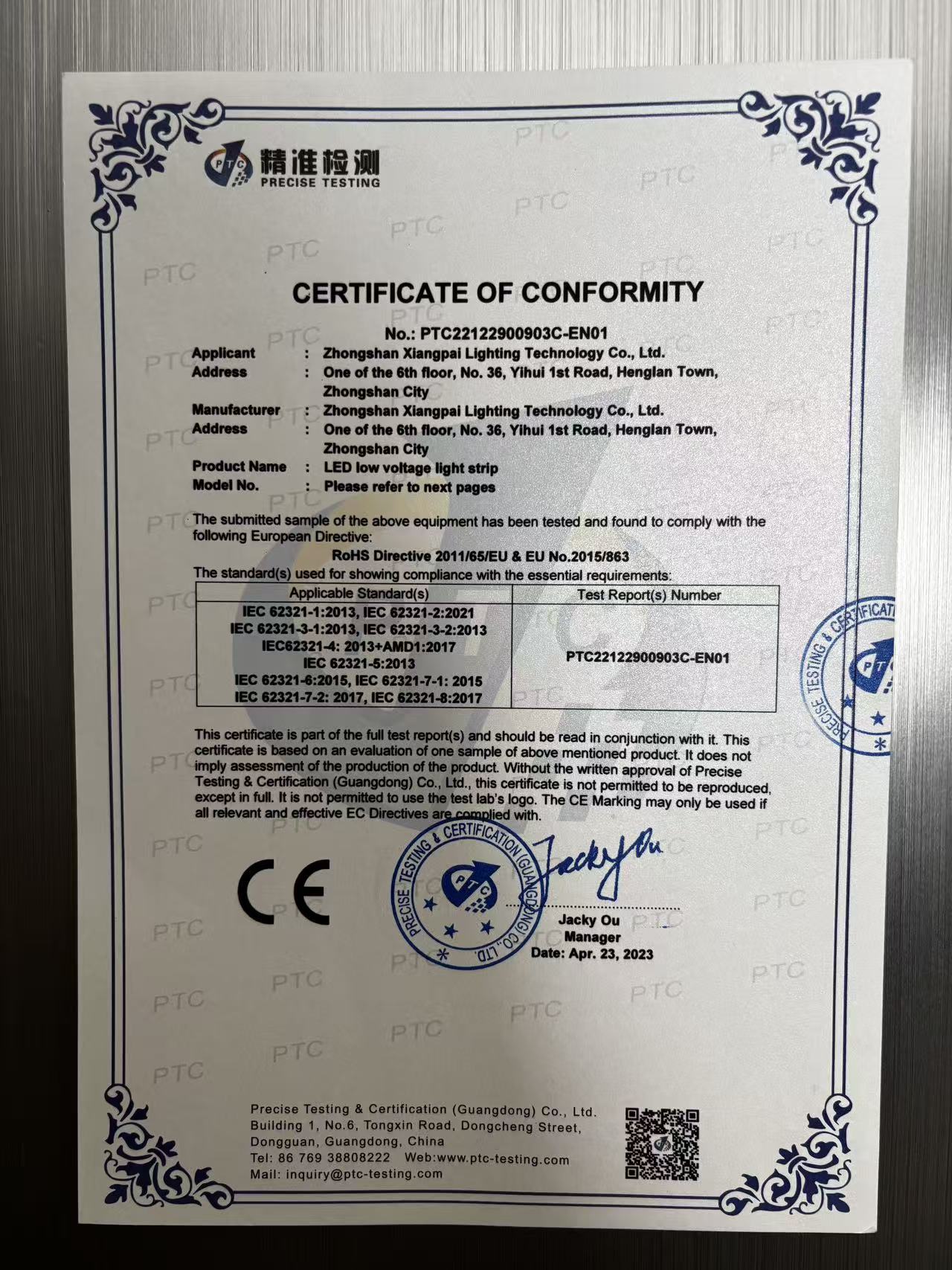
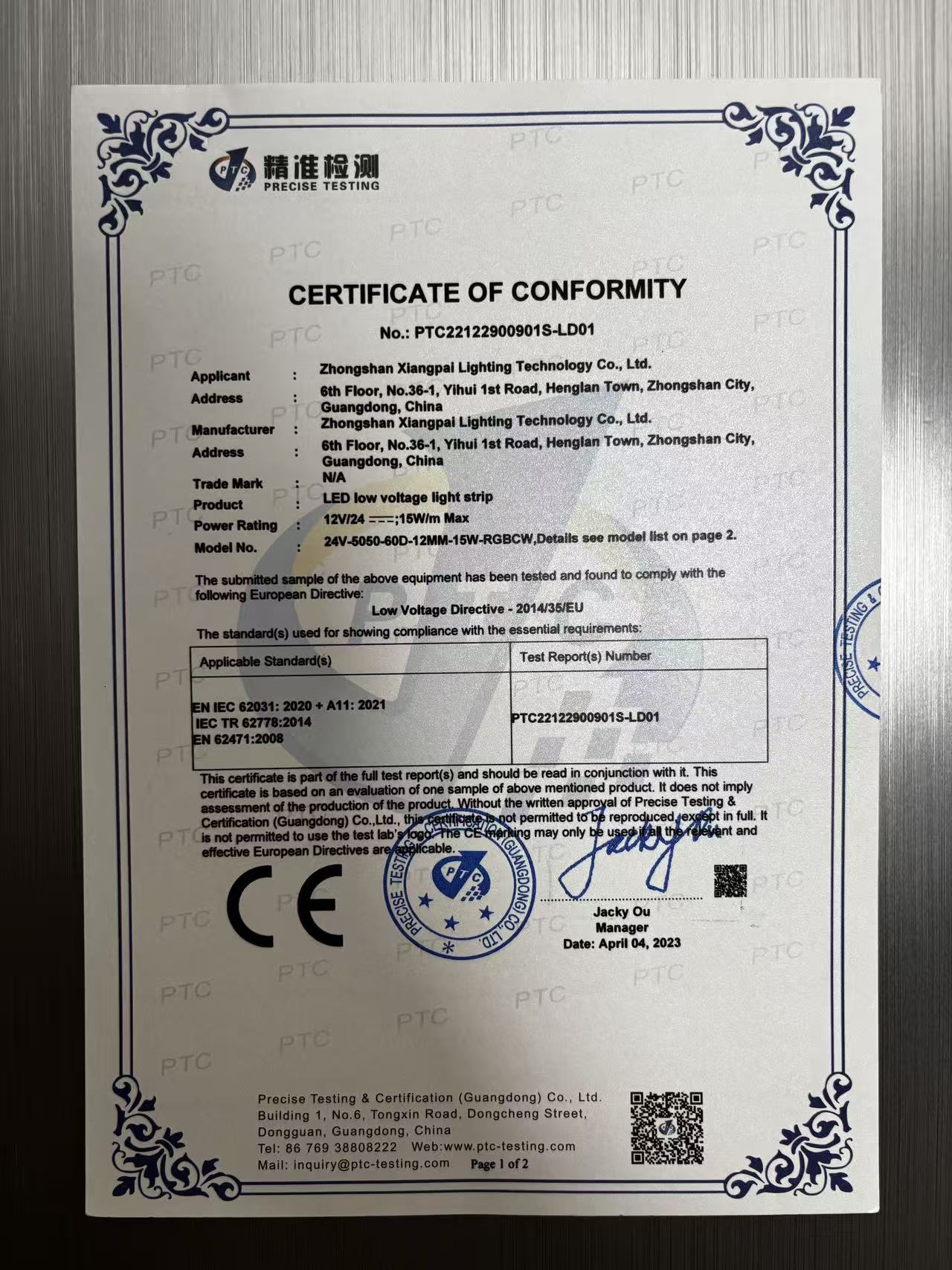
Institutional procurement usually requires certification evidence before a sample is approved. XPUP holds CE certification documentation for its LED low-voltage and high-voltage light strip series, issued by PTC TESTING for the EU market.
| Certification | Certificate numbers | Standards cited | Issue date |
|---|---|---|---|
| CE — LVD | PTC22122900901S-LD01; PTC22122900902S-LD01 | EN IEC 62031:2020 + A11:2021; IEC TR 62778:2014; EN 62471:2008 | 2023-04-04 |
| CE — EMC | PTC22122900901E-EMB01; PTC22122900902E-EMB01 | EN IEC 55015:2019 + A11:2020; EN 61547:2009; EN IEC 61000-3-2:2019 + A1:2021; EN 61000-3-3:2013 + A1:2019 | 2023-03-09 |
| CE — RoHS | PTC22122900903C-EN01; PTC22122900905C-EN01 | IEC 62321 series (parts 1, 2, 3-1, 3-2, 4, 5, 6, 7-1, 7-2, 8) | 2023-04-23 |
Acceptance and commercial terms for these orders are standardised: acceptance is based on pre-shipment testing, production is 100% tested, MOQ is 2,000 meters, delivery terms are FOB or CIF, and payment terms are 30% deposit with the balance payable before shipment.
Frequently Asked Questions
Are XPUP's LED strips certified for EU museum and gallery projects?
CE certification documentation is held for XPUP's LED low-voltage and high-voltage light strip series, issued by PTC TESTING for the EU market. The LVD report (PTC22122900901S-LD01 and PTC22122900902S-LD01, issued 4 April 2023) cites EN IEC 62031:2020 + A11:2021, IEC TR 62778:2014 and EN 62471:2008. The EMC report (PTC22122900901E-EMB01 and PTC22122900902E-EMB01, issued 9 March 2023) cites EN IEC 55015:2019 + A11:2020, EN 61547:2009, EN IEC 61000-3-2:2019 + A1:2021 and EN 61000-3-3:2013 + A1:2019. The RoHS report (PTC22122900903C-EN01 and PTC22122900905C-EN01, issued 23 April 2023) cites the IEC 62321 series.
Can XPUP serve as an OEM energy-saving LED lighting manufacturer for commercial projects?
XPUP provides OEM and ODM production services for LED strip and linear lighting products used in commercial projects. OEM customization covers voltage, logo, power, dimensions, materials, hardware configuration, internal circuit, colour, factory specifications, nameplate and label. ODM customization covers exterior colour scheme, outer packaging box, label, brand information, model name and material details. Published commercial parameters are monthly capacity 3,000,000 meters, MOQ 2,000 meters, 100% product testing, and export markets covering the EU, Asia and the US.
What is the minimum order quantity, and how are payments and delivery structured?
MOQ is 2,000 meters. Delivery terms are FOB or CIF. Payment terms are 30% deposit with the balance payable before shipment, and acceptance is based on pre-shipment testing. These terms apply to the OEM and ODM LED strip orders described in this guide.
How does a buyer validate CRI, CCT and density before mass production?
Validation runs through sampling and testing. XPUP supports rapid sampling, applies 100% product testing, and uses pre-shipment testing as the acceptance criterion. For a museum or gallery run, the sample of the specified model — XP-BD18DC24V-2835-140D-8MM at Ra≥97 or DK3-DC24V-2835-240D-9.3mm at Ra≥80 — should be checked against the CCT set, PCB width and LED density stated on the specification sheet before the order is released.
What is the production lead time for a museum or gallery LED strip order?
Lead time is 18–22 days, and monthly production capacity is 3,000,000 meters. XPUP states that it prepares inventory during low seasons to maintain supply during peak seasons, which supports projects with fixed installation dates. To confirm a schedule, request a sample or quotation for DK3-DC24V-2835-240D-9.3mm or XP-BD18DC24V-2835-140D-8MM by emailing sales001@xpupled.com or visiting www.xpupled.com.
Conclusion: A Repeatable Selection Logic for Museum and Gallery LED Lighting
Museum and gallery LED lighting selection reduces to a sequence that can be repeated on every project: classify the zone, set the CRI threshold (Ra≥97 for colour-critical positions, Ra≥80 for architecture), fix the CCT schedule, confirm 24V DC driver architecture, match density and PCB width to the detail, verify the IP rating against the environment, approve a physical sample, and lock the compliance documents and lead time before production. XP-BD18DC24V-2835-140D-8MM and DK3-DC24V-2835-240D-9.3mm cover the two ends of that sequence in one supplier's range, which removes the need to reconcile two different manufacturers' specification sheets on a single gallery scheme.
Written this way, the specification survives the two reviews that most often delay a cultural project: the designer's colour review and the procurement team's documentation review.
Next step: sample, specification review or quotation
XPUP LED (Zhongshan Xiangpai Lighting Technology Co., Ltd.) supplies LED strip and linear lighting to lighting brands, engineering contractors and importers, with OEM and ODM services for museum, gallery, hospitality and commercial projects.
- Email: sales001@xpupled.com
- Tel / WhatsApp / WeChat: +86 189 8858 4085
- Website: www.xpupled.com
- Contact: Gabin
- Address: 5th Floor, No.36-1, Yihui 1st Road, Henglan Town, Zhongshan City, Guangdong Province, CHINA
- Catalog download: 2026 XPUP LED Strip Catalog (PDF)
Have Questions or Need More Details?
Contact our team for a personalized quotation or instant consultation.
Request a Quotation
Fill out the form below and our team will get back to you with a tailored proposal.
WhatsApp Direct Chat
Prefer to chat in real-time? Message us on WhatsApp for instant assistance & quick answers.
- Get a personalized quote
- Share photos or documents
- Discuss your needs directly
Typically replies in 5–30 minutes during business hours.