
Museum Lighting Gone Wrong: Why Standard LEDs Fail and How Full-Spectrum Fixtures Solve It
A museum lighting failure is often visible before anyone reads a specification. A red pigment turns brown, a wood surface looks flat, or two adjacent walls appear to be different colors even though both fixtures are labelled 3000K. In galleries, jewelry stores, and luxury retail displays, the same problem appears as merchandise that loses depth, stones that look dull, or a display case that no longer matches the rest of the room. The cause is usually not a dead LED. It is a mismatch between the color task and the light source.
Standard LEDs can meet a nominal color temperature and still render colors poorly. That gap is the reason color-critical projects ask for high CRI and full-spectrum options rather than CCT alone. The products discussed here come from XPUP LED, the brand of Zhongshan Xiangpai(XPUP) Lighting Technology Co., Ltd, a LED strip manufacturer established in 2012 in Zhongshan, China. For this problem, the relevant products are the XP-BD18DC24V-2835-140D-8MM full-spectrum strip and the DK3-DC24V-2835-240D-9.3mm linear strip. They do not serve the same role, and the difference matters to specifiers.
Why Standard LEDs Go Wrong in Museums, Galleries and Jewelry Stores
The clearest failure is visible color shift. Two LED products can both be listed as 3000K, yet one makes a warm white wall look clean and another makes it look slightly green or grey. In a museum, that difference changes how a painting, textile, ceramic, or manuscript is perceived. In a jewelry store, it changes how a diamond, gold band, pearl, or colored stone is judged. The viewer is not comparing lumens. The viewer is comparing color.
A second failure is poor color rendering. A standard LED may produce a high enough light level while leaving gaps in the spectrum that matter to the object. Reds, browns, skin tones, wood grains, and some pigments can look muted or inconsistent under that light. The object is physically unchanged, but its appearance is not faithful. For a gallery, this can make an artist’s intended color relationships look wrong. For a luxury retailer, it can make a premium product look ordinary.
A third failure is inconsistency across a project. If one batch of strip is used in a display case and another batch is used on the wall behind it, small differences in CCT or color rendering can become visible at the boundary. The eye is sensitive to adjacent differences, especially on neutral walls and white display surfaces. A specification that controls only the nominal CCT does not control this risk.
The practical rule: color temperature tells you how warm or cool the light looks. CRI tells you how well the source renders colors by comparison with a reference. A project that needs accurate color needs both, plus a sample check under the actual viewing conditions.
What Color-Critical Lighting Has to Deliver
Museums, galleries, and jewelry stores share one lighting condition: the viewer is making a visual judgment. The lighting has to support that judgment without becoming the subject. That means the source should render object colors as faithfully as the project requires, keep a consistent white point across adjacent fixtures, and fit the architecture so the light does not create glare, shadows, or visible hot spots.
CRI is the first specification most buyers check. A higher CRI indicates closer color rendering to a reference source, with 100 as the maximum. The XP-BD18DC24V-2835-140D-8MM is rated Ra≥97. The DK3-DC24V-2835-240D-9.3mm is rated Ra≥80. That is a real difference, and it should not be flattened into a generic claim that all linear LED products are equally suitable for color-critical display.
CRI is still not the whole specification. It is a metric, not a complete museum conservation standard, and it does not by itself prove that a fixture meets every project requirement. Buyers should verify the full specification, the installed appearance, and any institutional or conservation requirements that apply to the collection. The useful point is narrower: when the problem is visible color shift and poor rendering, a Ra≥97 full-spectrum option is a more appropriate starting point than a standard Ra≥80 linear strip.
Color temperature is the second decision. The XP-BD18 model covers 2700K, 3000K, 3500K, 4000K, 5000K, and 6000K. The 3000K, 4000K, and 6000K options are the ones most often discussed for museum, gallery, and retail work, but the full range gives the specifier room to match the project. The DK3 model covers 3000K, 4000K, and 6500K. Note the difference: the DK3 data lists 6500K, not 6000K. That is exactly the kind of detail a specifier should confirm before issuing a purchase order.
The Full-Spectrum Fix: XP-BD18DC24V-2835-140D-8MM
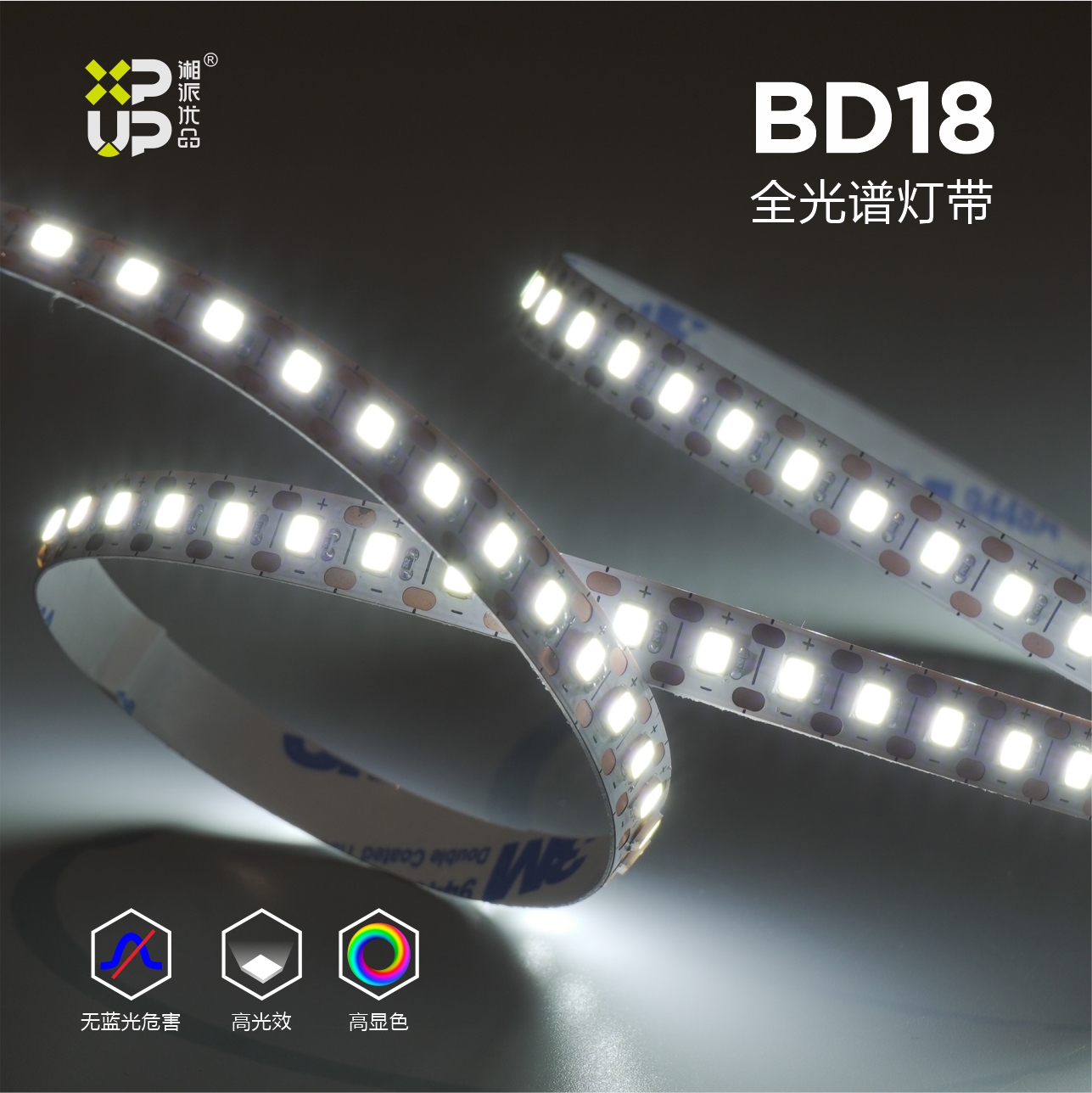
The XP-BD18DC24V-2835-140D-8MM is a 24V, 12W full-spectrum LED strip with a CRI of Ra≥97, an 8mm PCB, 140 LEDs per meter, 2835 SMD chips, a double-layer copper PCB, and IP20 protection. It is classified by XPUP as Full Spectrum Lighting. Its listed applications include museums and galleries, interior design, luxury retail, jewelry stores, education, and shopping malls. The product data also describes it as suitable for jewelry stores and display cases.
For a museum or gallery, the value of the XP-BD18 is not simply that it is bright. It is that the strip is designed around a higher color-rendering target while remaining a linear format that can be integrated into display cases, coves, shelves, and architectural details. The 8mm PCB is narrow enough for compact profiles, and the 140 LEDs per meter density supports a smooth line of light rather than a visible string of points. The product data also notes that each LED is cuttable for various lengths, high brightness, good flexibility, and strong bending resistance. Those are practical details for display-case work and curved architectural details.

The 24V, 12W configuration is also relevant to project integration. A 24V strip is a low-voltage format that fits the driver and control discussions that belong to the fixture design, not just the strip purchase. The 12W rating and 140 LEDs per meter should be checked against the profile, diffuser, and power supply plan. The article does not convert those values into a lighting design; it identifies what the specifier must verify.
One important clarification: a full-spectrum strip is a light engine, not a complete museum fixture. The final performance depends on the driver, diffuser, profile, mounting, and installation. The XP-BD18 gives the specifier a high-CRI light engine with documented CCT options and an 8mm PCB. It does not replace the need to test the assembled fixture in the actual display environment.
DK3 Linear Lighting: Uniform Light, Different CRI Boundary
The DK3-DC24V-2835-240D-9.3mm is a different tool. It is a 24V, 15W linear LED strip with a 9.3mm PCB, 240 LEDs per meter, 2835 SMD chips, a double-layer copper PCB, IP20 protection, and a CRI of Ra≥80. Its listed applications include restaurants, interior design, office buildings, apartments, and museums and galleries. The product data highlights high density, uniform light emission, and no grainy appearance, making it suitable for indoor lighting strips and black profiles.
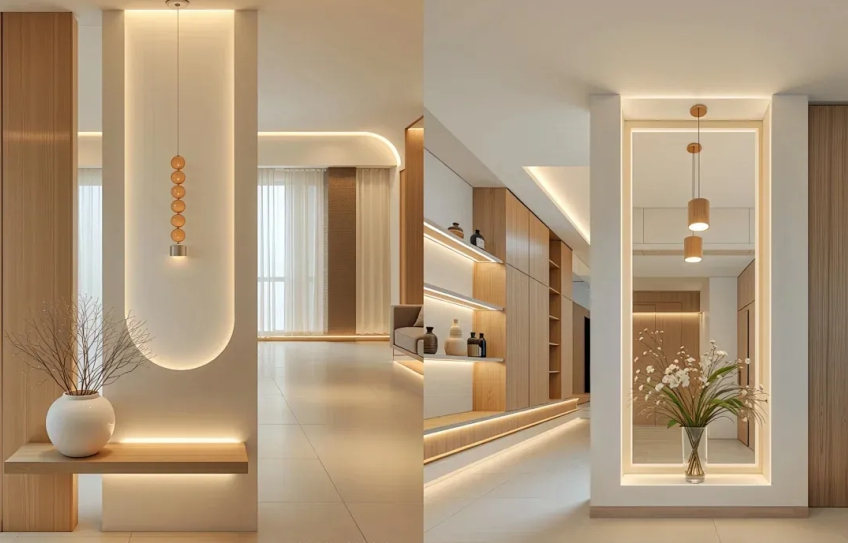
That makes the DK3 useful where the design priority is a continuous, even line of light, especially in black profiles or architectural details where a grainy appearance would be objectionable. It is not, however, the same color-rendering specification as the XP-BD18. The DK3 is rated Ra≥80, while the XP-BD18 is rated Ra≥97. A project that needs the highest color fidelity in the supplied range should start with the XP-BD18. A project that needs a high-density linear light for a less color-critical area, or for an architectural line where uniformity is the main requirement, can consider the DK3 with that Ra≥80 boundary clearly understood.
This distinction is important because the article topic is not “all linear LED is the same.” The failure mode in museums and galleries is often a specification that treats CCT as sufficient. The DK3 shows why the buyer must read the CRI line as carefully as the CCT line. If a specifier assumes that every DK3 or every linear strip is Ra≥97, the project can repeat the original problem in a different form.
Specifying a Full-Spectrum Retrofit: Step by Step
Step 1: Define the color-critical task. Ask what the viewer must judge. A painting, textile, ceramic, jewelry stone, watch dial, or luxury handbag each places a different demand on color rendering. The XP-BD18 data supports museums and galleries, luxury retail, jewelry stores, and display cases. That is the starting point, not the final answer. The specifier should identify the object, the viewing distance, the background color, and whether the display is a case, a wall, or a freestanding fixture.
Step 2: Set CRI and CCT together. For color-critical display, the XP-BD18’s Ra≥97 is the relevant CRI starting point in the supplied product range. Then choose the CCT from 2700K, 3000K, 3500K, 4000K, 5000K, or 6000K. The 3000K option is often associated with warm gallery and retail environments, while 4000K and 6000K can be considered where a cooler or more neutral appearance is required. These are application decisions, not universal rules. The project’s own visual mock-up should decide.
Step 3: Match the PCB to the architecture. The XP-BD18 uses an 8mm PCB. The DK3 uses a 9.3mm PCB. PCB width is one of the first mechanical checks because the strip must fit the selected profile, diffuser, and mounting detail. The XP-BD18 data also notes an ultra 5mm/8mm linear LED strip family with RA90/97 options; the specified XP-BD18DC24V-2835-140D-8MM is the 8mm, Ra≥97 version. The DK3’s 9.3mm format is a different mechanical envelope. A specifier should not treat the two as interchangeable without checking the profile.
Step 4: Validate the assembled fixture, not just the strip. A sample should be reviewed under the actual viewing conditions, with the actual diffuser and the actual object or a representative color target. This is where visible color shift, hot spots, and excessive brightness become obvious. The sample step is also the point to confirm that the Ra≥97 strip still performs as expected after the optical system is assembled.
Step 5: Confirm the electrical and control plan. Both models are 24V and IP20. The XP-BD18 is 12W with 140 LEDs per meter; the DK3 is 15W with 240 LEDs per meter. Those values belong in the driver, dimming, and thermal plan. The project should use a proper power supply and adapter, avoid overload, and keep the installation within the intended indoor dry environment. The application data also notes operating conditions of -20℃ to +45℃, no covering with objects, and keeping away from chemically corrosive environments. Those conditions should be carried into the fixture specification.
Step 6: Lock the OEM/ODM variables. If the project needs a private-label or modified version, the OEM/ODM discussion should cover voltage, logo, power, dimensions, materials, hardware configuration, internal circuit, color, factory specifications, nameplate, and label. ODM support can also cover exterior color scheme, outer packaging box, label, brand information, model name, and material details. These are the variables that let a specifier match the strip to a precise architectural requirement rather than forcing the architecture to accept a catalogue default.
Where the Two Products Fit: Museums, Galleries, Jewelry and Luxury Retail
For museum and gallery display cases, the XP-BD18’s Ra≥97 and 8mm PCB make it the closer match when the object’s color is the reason for the lighting. The 140 LEDs per meter density supports a smooth line in a compact case. The cuttable format helps with different lengths. The 3000K, 4000K, and 6000K options, plus the wider 2700K to 6000K range, allow the specifier to match the collection and the room.
For jewelry stores and luxury retail, the same logic applies, but the commercial risk is more direct. A ring, necklace, or watch is evaluated under the light. A high-CRI strip is intended to help the merchandise look closer to its true color. The XP-BD18 data explicitly lists jewelry stores and display cases, and its application list includes luxury retail and shopping malls. That does not mean every jewelry display should use the same CCT. It means the strip is a supported candidate when color rendering is the priority.
For architectural lines, black profiles, and areas where a uniform line of light matters more than the highest CRI, the DK3 can be the more practical choice. Its 240 LEDs per meter and high-density construction are aimed at uniform emission and no grainy appearance. It is listed for museums and galleries as well, but its Ra≥80 rating means the specifier must decide whether that level is sufficient for the specific display. In a mixed project, the two products can serve different zones, provided the CRI and CCT boundaries are documented and the transitions are checked.
Specification Comparison: XP-BD18 vs DK3
| Specification | XP-BD18DC24V-2835-140D-8MM | DK3-DC24V-2835-240D-9.3mm |
|---|---|---|
| Product type | Full Spectrum Lighting | Linear Lighting |
| CRI | Ra≥97 | Ra≥80 |
| Color temperature | 2700K, 3000K, 3500K, 4000K, 5000K, 6000K | 3000K, 4000K, 6500K |
| PCB width | 8mm | 9.3mm |
| LED density | 140 LEDs per meter | 240 LEDs per meter |
| Power and voltage | 12W, 24V | 15W, 24V |
| IP rating | IP20 | IP20 |
| Documented application fit | Museums and galleries, luxury retail, jewelry stores, display cases, education, shopping malls | Museums and galleries, restaurants, interior design, office buildings, apartments, black profiles |
| Best use of the difference | Color-critical display where Ra≥97 is the priority | Uniform high-density linear light where Ra≥80 is acceptable |
The table is not a ranking. It is a boundary map. The XP-BD18 is the higher-CRI option in the supplied data. The DK3 is the higher-density, 9.3mm linear option with a different CRI rating. A project can use either, but the specification should say which one and why.
OEM/ODM and PCB Formats for Architectural Integration
OEM and ODM support matter most when the standard product is close but not exact. XPUP’s OEM capability covers voltage, logo, power, dimensions, materials, hardware configuration, internal circuit, color, factory specifications, nameplate, and label. ODM capability covers exterior color scheme, outer packaging box, label, brand information, model name, and material details. For a museum or luxury retail project, those variables are not cosmetic. They determine whether the strip fits the display case, matches the brand’s documentation, and arrives in a format the installer can use.
The documented manufacturer terms are also relevant to project planning. XPUP lists a monthly capacity of 3,000,000 meters, a MOQ of 2,000 meters, a lead time of 18–22 days, 100% testing, and a 2-year standard warranty. Those are manufacturer facts, not a promise that every custom project will follow the same schedule. They give the buyer a baseline for the commercial discussion. A project with a short installation window should confirm the schedule in writing rather than assume the standard lead time covers every customization.
The 8mm and 9.3mm PCB formats are part of the architectural fit. An 8mm strip can suit a slimmer profile, while a 9.3mm strip may suit a different profile or a black linear detail. The specifier should check the internal width of the profile, the diffuser, the bend radius, the cut point, and the mounting method. The product data supports the formats and the cuttable LED detail; it does not declare every profile compatible. That check belongs to the project.

Quality, Lead Time and Manufacturer Verification
XPUP LED is not only a product name. It is the brand of Zhongshan Xiangpai(XPUP) Lighting Technology Co., Ltd, a manufacturer established in 2012 with a factory of more than 10,000 square meters, 80 employees, 6 engineers, and an annual output of 35,000,000 meters. The company lists LED strip as its main product, with 50% export share and main markets in the EU and USA. Its products hold CE and RoHS certifications and are manufactured in accordance with applicable safety, environmental, and energy-efficiency standards.
Those facts help a buyer answer the manufacturer question, but they do not replace a project audit. A buyer should still verify the specific product data sheet, the CRI and CCT of the ordered batch, the PCB width, the IP rating, the warranty terms, and the packaging requirements. The 100% test claim and 2-year warranty are useful checkpoints in that review. They are not a substitute for the buyer’s own sample approval.
XPUP also reports long-term ODM supply to a U.S. lighting brand at 300,000 meters per year over three years for private-label retail and project supply. That case supports the manufacturer’s ODM capability and continuity. It is not a museum case study, and it should not be presented as proof of a museum installation. The relevant lesson is narrower: the company has a documented ODM supply model for overseas lighting brands.
FAQ
Why do standard LEDs look wrong in museums and galleries?
Standard LEDs can meet a nominal color temperature while still rendering some colors poorly. In a museum or gallery, that appears as visible color shift: reds may look brown, wood may look flat, and adjacent white walls may not match. The issue is usually the combination of CRI, spectrum, and batch consistency, not the CCT label alone.
What CRI should museum and gallery lighting specify?
There is no single CRI that fits every museum or gallery. In the XPUP range, the XP-BD18DC24V-2835-140D-8MM is rated Ra≥97, while the DK3-DC24V-2835-240D-9.3mm is rated Ra≥80. A color-critical display should start with the higher-CRI option and then verify the assembled fixture under the actual viewing conditions. CRI is a useful metric, but it is not the only project requirement.
Is the XP-BD18 suitable for jewelry stores and display cases?
Yes. The XP-BD18 product data lists jewelry stores and display cases among its intended uses, along with museums and galleries, luxury retail, and shopping malls. The model uses an 8mm PCB, 140 LEDs per meter, and a Ra≥97 rating. The final suitability still depends on the case design, diffuser, driver, and sample approval.
What PCB widths are available for architectural integration?
The XP-BD18DC24V-2835-140D-8MM uses an 8mm PCB. The DK3-DC24V-2835-240D-9.3mm uses a 9.3mm PCB. The XP-BD18 product data also describes an ultra 5mm/8mm linear LED strip family with RA90/97 options, while the specified model is the 8mm, Ra≥97 version. Specifiers should check the profile, diffuser, bend radius, and cut point before selecting a format.
Is XPUP LED a manufacturer for hospitality projects?
Yes. XPUP LED is the brand of Zhongshan Xiangpai(XPUP) Lighting Technology Co., Ltd, a LED strip manufacturer established in 2012 with a 10,000 square meter factory, 80 employees, 6 engineers, and an annual output of 35,000,000 meters. Its documented OEM/ODM capability covers voltage, CCT, PCB, packaging, labels, and brand details, and its hospitality application data includes the XP-BD18 among applicable products. For a hospitality project, the product choice still depends on the CRI, CCT, PCB width, and profile. A sample request or project quote can begin with the 2026 XPUP LED Strip Catalog.
Conclusion
Museum lighting goes wrong when a standard LED is chosen for its CCT label and not for its color-rendering performance. The visible result is color shift, dull merchandise, and adjacent surfaces that do not match. The fix is not a more decorative fixture. It is a more appropriate light engine, specified with CRI, CCT, PCB width, and the actual display task in view.
In the XPUP range, the XP-BD18DC24V-2835-140D-8MM is the full-spectrum, Ra≥97 option for museums, galleries, jewelry stores, luxury retail, and display cases. The DK3-DC24V-2835-240D-9.3mm is the high-density, 9.3mm linear option for uniform light and black profiles, with a Ra≥80 boundary that should be stated clearly. OEM/ODM support and the 8mm/9.3mm PCB formats give specifiers a way to match the architecture rather than compromise it.
For a color-critical project, review the XPUP LED Strip Catalog and request a sample of the XP-BD18 full-spectrum strip for evaluation under your own display conditions.
Have Questions or Need More Details?
Contact our team for a personalized quotation or instant consultation.
Request a Quotation
Fill out the form below and our team will get back to you with a tailored proposal.
WhatsApp Direct Chat
Prefer to chat in real-time? Message us on WhatsApp for instant assistance & quick answers.
- Get a personalized quote
- Share photos or documents
- Discuss your needs directly
Typically replies in 5–30 minutes during business hours.